

Supplements and Absorption - Are You Actually Absorbing Your Supplements?
Are You Actually Absorbing Your Supplements?
Absorption depends on factors like solubility, stability in a person’s digestive tract, and how easily a nutrient or active can cross into the bloodstream. CoQ10, for example, is a fat-soluble nutrient and can be difficult to absorb in basic formulations, meaning a portion may pass through the body unused. Not all supplements face the same challenge. Because nutrients and actives behave differently in the body, they require unique, tailored transport mechanisms to be effectively delivered. Vitamin C, for instance, is poorly absorbed at functional doses and requires active transport within a lipid vesicle to overcome cellular uptake limitations. Conversely, B vitamins are highly sensitive to degradation during digestion and will only absorb effectively once safely shielded through the harsh gastric system. Even minerals like magnesium can be well absorbed when delivered in forms like magnesium glycinate or citrate. Rather than assuming certain nutrients and actives absorb easily, it is more accurate to recognize that each requires a bioeffective approach tailored to its unique transport and stability challenges.
Why Absorption & Efficacy Matters
Absorption is the critical first step in determining a nutrients or actives’ value. Once an active reaches the small intestine, it must pass through the intestinal lining and enter the bloodstream—a process heavily dictated by its molecular structure, transport mechanisms, and whether the compound is water- or fat-soluble.
Historically, the industry has focused almost exclusively on “bioavailability,” the percentage of a nutrient or active that successfully enters circulation. However, bioavailability only tells part of the story. High bioavailability means nothing if the nutrient or active is structurally compromised by gastric acid before it is absorbed.
The ultimate benchmark for performance-driven formulations is bioefficacy—the nutrient’s or actives’ measurable effectiveness in achieving its intended biological outcome at the cellular level. Nutrients and actives bioefficacy directly impact outcomes like energy production, immune support, and muscle recovery. For both the formulator and the consumer, effectiveness is not just about what is on the label or even how much enters the blood; it is about ensuring the ingredient survives digestion intact and arrives precisely where the body can utilize it to perform its function.
Fat Soluble vs. Water Soluble
Not all nutrients and actives behave the same way in the digestive tract. Water-soluble nutrients, such as vitamin C and B vitamins, are often incorrectly assumed to be highly bioavailable. In reality, they depend heavily on advanced transport mechanisms reach optimal absorption sites and achieve true bioefficacy. Similarly, fat-soluble nutrients like CoQ10, vitamin D, and carotenoids require precise structural dispersion to be absorbed effectively. Ultimately, nutrients and actives delivery technology is a defining factor in how well they work in the body. Fat-soluble nutrients like CoQ10, vitamin D, and carotenoids require dietary fat and proper dispersion to be absorbed effectively. Fat-soluble nutrients are more dependent on how they are formulated, making delivery technology a key factor in how well they ultimately work in the body.
Quick Look:
Water-soluble (e.g., vitamin C, B vitamins):
Prone to transport saturation or gastric degradation; require lipid vesicles and gastric shielding for effective delivery.Fat-soluble (e.g., CoQ10, vitamin D, carotenoids):
Require fats and proper dispersion to be absorbed effectively
What This Means For Consumers
By choosing formulations designed to support both bioavailability and bioefficacy, consumers can get more value from their supplement routine without relying on higher doses. Rather than assuming more is better, the focus shifts to how efficiently a nutrient or active is transport and released and how effectively it performs once in the body.
When both absorption and efficacy are optimized, lower doses may be sufficient to support benefits such as energy, immunity, and cognition. This approach supports more consistent results and can improve long-term cost effectiveness.
In addition, the delivery format of a supplement, whether it is a traditional capsule, powder, gummy, or softgel, plays a significant role in how well a nutrient or active is dispersed and stabilized within the application. Poor stability can lead to degradation of the nutrient or active meaning its bioefficacy may differ from its intended function before it is even ingested. If a nutrient or active is not effectively stabilized in its final format, this can result in reduced performance or even unintended physiological effects (for example, the conversion of creatine to creatinine).
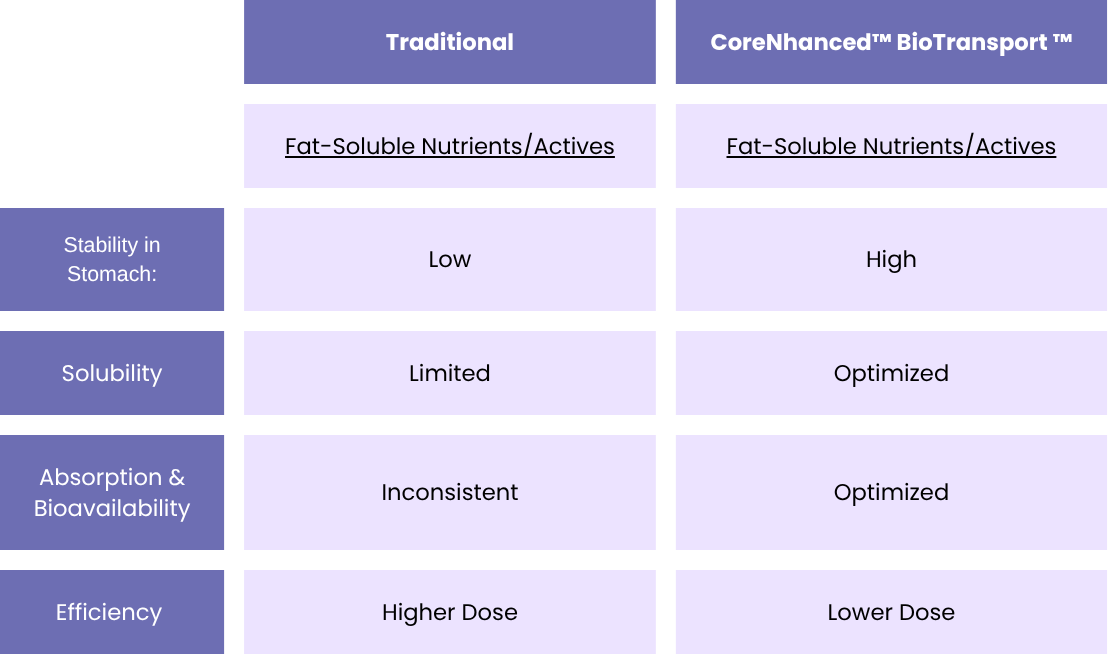
Traditional vs CoreNhanced™
Enhanced In Vivo Transport Systems
CoreNhanced™ BioTransport™ with Gastric Shielding™ advanced technology systems are engineered to solve the precise structural and chemical limitations of nutrients and actives from nature.
Gastric Shielding™ acts as a targeted physical barrier, protecting sensitive micro-nutrients and bioactives from harsh stomach acids and enzymatic degradation. By preserving the integrity of the active nutrient or bioactive, it ensures the compound reaches the small intestine fully intact and ready for optimal uptake. By preventing early degradation, this technology maximizes survivability, driving not just higher absorption rates, but true bioefficacy.
CoreFX’s BioTransport™ technology bridges the gap between bioavailability and bioefficacy. By addressing nutrient-specific or active-specific stability and transport challenges through digestion, the platform increases the sheer volume of nutrients and actives entering the bloodstream and ensures those nutrients and actives arrive in a state primed to achieve their biological purpose.